
Who does this apply to?
- Spouse or cohabiting partner of a resident/guarantor in Curaçao
- Minor children (or dependent adult children in specific cases) of a resident/guarantor in Curaçao
- Parents of a resident/guarantor in Curaçao (via 'extended family reunification')
Costs
- First application: XCG 655 ≈ US$ 366
- Renewal: XCG 625 ≈ US$ 349
- Other costs: Change of situation (e.g. the guarantor stops working, etc.): XCG 615
- Fee per year of validity. Since 1 April 2026 you can request the permit for 1, 2 or 3 years and pay each year's fee up front (for example, 3 years = XCG 1.905). See what changed on 1 April 2026 (Spanish) →
Dollar amounts are approximate, at the fixed rate of US$ 1 = XCG 1.79. You pay in XCG.
Decision time
4 months. For the FIRST application, the decision must be awaited outside Curaçao ('afwachten in het buitenland'). For renewals, it can be awaited within the island.
Requirements
- Proof of payment of fees and charges
- Original, fully completed and signed application form
- Copy of valid passport (all nationalities)
- Copy of birth certificate (no more than 1 year old; apostilled/legalized according to country of origin, except EU)
- Certificate of good conduct from the last place of residence (no more than 3 months old) for each family member over 18 years old
- If applicable, marriage: marriage certificate (or its registration in Curaçao if married abroad)
- If cohabiting without marriage: notarial cohabitation agreement concluded in the Netherlands/BES + proof of being single/divorced/widowed
- Original Guarantee Declaration signed by the guarantor (with an XCG 10 adhesive stamp)
- Original, signed Employer Declaration of the guarantor (with an XCG 10 adhesive stamp) and copy of the employer's ID
- Guarantor's CRIB number (and the company's, if applicable)
- If the guarantor owns their own business or is a director of an NV/BV: copy of the establishment permit, Chamber of Commerce extract (no more than 6 months old), copy of management license if applicable
- Original Tax Inspectorate declaration showing a taxable base of at least XCG 36,000 for the last 2 years
- Guarantor's minimum income: XCG 1,500/month gross if of Dutch nationality, XCG 3,000/month if foreign; plus XCG 250-500/month per child depending on age
- For a child's application: current-year school enrollment declaration
- Minimum salary requirement: if a Dutch national marries a foreigner, the Dutch national must have a minimum salary of XCG 1,500/month; if both spouses are foreigners, the main applicant must have at least XCG 3,000/month. For each foreign or Dutch child (not born in Curaçao) included in the application, the following is added as an additional financial guarantee: XCG 250/month (up to 5 years old), XCG 350/month (up to 11 years old), XCG 500/month (12 years or older).
Steps to apply
- Identify which of the 3 sub-procedures applies: spouse/partner, children, or parents
How to get this done
Review which of the 3 sub-procedures describes your situation: spouse/cohabiting partner, minor children (or dependent adult children in specific cases), or parents of a resident (via 'extended reunification'). Each has its own document list — see the 'Requirements' section above.
- Gather the specific requirements for a first application, renewal, or change according to your situation
How to get this done
Use the 'Requirements' list on this same page, filtering by your exact situation (first application, renewal, or change) — not all documents apply equally to all 3 cases.
- Scan everything as PDF meeting the official scanning criteria
How to get this done
How to scan your documents correctly
The scan (or photo) of each document must meet ALL these criteria, or the system may reject your application: (1) it must be a scan of an ORIGINAL document, not a copy of a copy; (2) scanned as straight as possible, not tilted; (3) no staples, paper clips or fingers visible in the image; (4) not edited or retouched; (5) avoid folds and creases; (6) all data must be sharp, legible and not blurry; (7) no crossed-out, covered or overwritten data; (8) for identity documents the image must show the WHOLE document in colour (passport: top and bottom page; cédula: front and back); (9) leave about 2 cm of margin around the image; (10) the document must NOT have a translucent/transparent background.
- Use a real scanner if you have access to one (office, library, copy shop): it gives better results than a phone photo.
- If you use your phone, do it in good daylight, without direct flash, with the document on a flat, dark surface so the edges are clearly visible.
- Save each document as a PDF (not a loose JPG) when the procedure explicitly asks for PDF format.
- Pay the corresponding amount (655 / 625 / 615 XCG) at Maduro & Curiel's Bank
How to get this done
Maduro & Curiel's Bank (MCB): to pay immigration fees (account 31967908, in the name of the Toelatingsorganisatie)
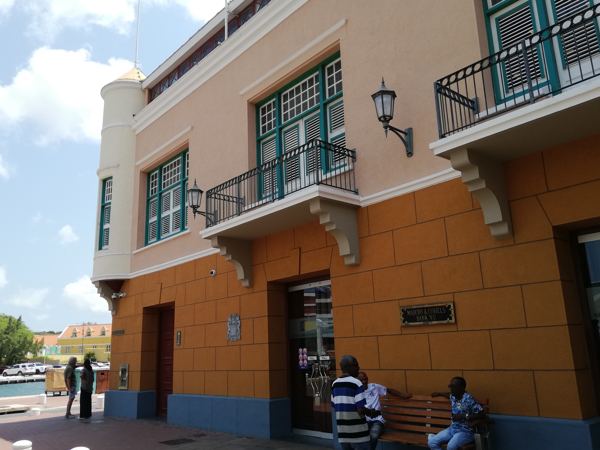
Plasa Jojo Correa 2-4, Punda, Willemstad, Curaçao (sede principal/Punda Head Office) — Google Maps
Monday to Friday 08:00–14:00 (main branch; other branches may differ)
No appointment is needed for a regular deposit or transfer. It is not confirmed whether payment can be made 100% through online banking or the app without visiting a branch: MCB offers digital banking, but we have not verified that transfers with a free-text reference (name + date of birth) are accepted without a branch visit. Ask the bank directly.
How to pay the fee for your procedure
Payment is made by deposit or transfer at Maduro & Curiel's Bank (MCB), account 31967908, in the name of the Toelatingsorganisatie (Rib'e Lugá also accepts payment at Banco di Caribe, account 36286001). ALWAYS put your full name and date of birth in the payment reference (some forms also ask for your passport number): without that reference the payment cannot be matched to your application. You must pay BEFORE submitting your application and show the original proof of payment if asked. Use the 'Payment order' form (on the procedure page) to find the exact amount for your case.
- Since 1 April 2026, if you apply for a permit for more than 1 year, you pay the fee for each year requested in advance; see the policy notice on the home page.
- Keep the paper receipt AND a photo/scan: you need it for the application AND as a back-up if there is a dispute.
- Submit the application online
How to get this done
How to submit your application online
The vast majority of Toelatingsorganisatie procedures are submitted by EMAIL to intake@immigrationcur.org (some objection/appeal procedures go to info@immigrationcur.org; check which applies to your case on the relevant page). Attach ALL documents, scanned according to the official criteria, plus the proof of payment. If an authorised representative submits the application (not you), a signed authorisation and a copy of their ID must also be attached. You will receive an acknowledgement of receipt by email; keep it as proof. Rib'e Lugá is the EXCEPTION: that procedure goes through the www.ribeluga.cw portal, not by email.
- Write a clear email subject (e.g. 'Application VTTV - [your full name]') so it is processed faster.
- Attach files with descriptive names (e.g. 'passport.pdf', 'birth-certificate.pdf') instead of generic names like 'scan001.pdf'.
- Keep a copy of everything you send: you will need it if you later have to object to a negative decision.
- If it is a first application: wait for the decision OUTSIDE Curaçao (up to 4 months)
How to get this done
What to do while you wait for the decision
The standard term is 4 months from the moment you submit the COMPLETE application (the clock does not run while something is missing). If this is your FIRST application for most procedures, you must wait for the decision OUTSIDE Curaçao (except renewals/changes, which may be awaited in the country). The decision is sent by email to the address you gave on the form; check your spam folder too. You can check the status of your application at any time (see the 'Check the status of an application' page).
- If you move or change your email address while waiting, report it immediately to info@immigrationcur.org: if they cannot reach you, they may refuse your application for 'failure to cooperate'.
- Do not buy final return tickets until you have the decision in hand if your plan depends on approval.
- If positive: schedule an appointment to receive the permit
How to get this done
Toelatingsorganisatie Curaçao (Admission Office)
Prinsenstraat 90, Punda, Willemstad, Curaçao — Google Maps
Monday to Thursday 08:00–15:00, Friday 08:00–12:00
Since Monday 24 November 2025 the office has been back in its renovated building at Prinsenstraat 90, Punda: the information desk and the issuing of residence titles (passport stamps) are there. The temporary location at Saliña 127 (Eurobuilding), used since September 2024, is no longer the Toelatingsorganisatie's address. The phone number is 733-2000; the old numbers 733-2080, 733-2081 and 733-2083 are no longer in use. Appointments to collect a passport stamp, proof of return, refund or final departure are booked through www.immigrationcur.org. For questions, email info@immigrationcur.org or message 'Admission Office Curaçao' on Facebook/Instagram.
- If negative: objection by email to info@immigrationcur.org within 6 weeks
How to get this done
How to object to a negative decision
You have 6 WEEKS from notification of the decision to file your objection (bezwaar) by email to info@immigrationcur.org. Your objection must include: your full name and address, a clear description of the decision you are challenging, why you disagree, what outcome you want, your signature, and an address in Curaçao if you live abroad. Attach a copy of the decision and any new evidence. If your objection is rejected (or you prefer to skip this step), you can appeal directly to the Court of First Instance of Curaçao; see the 'Objection and appeal' page for full details, including the legal strategy of asking for a 'provisional measure' (voorlopige voorziening) if you do not want to wait outside the country.
- Do not let the 6 weeks pass: after that deadline you lose the right to object this way.
- If your objection is against the refusal of a RENEWAL, by default you still have to wait outside the country, as with a first application, unless you EXPLICITLY ask the court for a provisional measure.

Downloadable forms
- Payment order DOCX · 853 KB
How to fill out this form
Betalingsopdracht / Orden de pago: the same form in different languages.
Form 910. This is the payment order you use at Maduro & Curiel's Bank (MCB) to pay the procedure fees BEFORE you submit your application. You only tick the box for your procedure: the amount is already fixed, you don't have to calculate anything.
Section single — Select your product/service: Mark (with an X or a circle) the line that matches your procedure EXACTLY. The amounts are already set per category; you don't have to add anything up yourself.
Proof of return XCG 225 Niet-van-Toepassing declaration XCG 225 Van Rechtswege declaration XCG 615 First application (study) XCG 625 First application (rentier/investor/own business/pensioner) XCG 635 First application (work/family reunification) XCG 655 Renewal (work/study/rentier/investor/pensioner/own business) XCG 615 Renewal (family reunification) XCG 625 Change of permit XCG 615 Internship stay XCG 525 Short stay XCG 535 Tourist stay XCG 525 Final departure XCG 145 Duplicate XCG 195 - Application form DOCX · 2.6 MB
How to fill out this form
Aanvraagformulier VTTV / Application Form VTTV: the same form in different languages, checked field by field.
This is the main form: it is used for the first application, renewal or change of almost every residence permit (work, family, study, rentier, investor, own business). It has 13 numbered sections. Only fill in the sections that apply to your case; leave the rest blank or write 'n/a'.
Section 1 — Reason for the application: Tick ONE box: first application, renewal or change (change only if you already had a valid permit).
Section 2 — Purpose of your stay: Tick the MAIN reason for your application (Employee, Director, Family reunification, Internship, Study, Own business, Rentier scheme, Rentier/Pensioner). If you have more than one reason, choose the main one: the other requirements of your specific procedure depend on this box.
Section 3 — Payment details: Date you paid and the exact amount in XCG. You must have PAID before submitting this form; attach the proof.
Section 4 — Personal details of the foreign national (the applicant): Your full details: surname, first names, date and place of birth, nationality(ies), FMSCRV number (only if you had a permit before), address abroad AND in Curaçao, phone, email (the decision is sent there), passport details, and marital status (married/divorced, with dates).
Section 5 — Partner's details: Only if you have a spouse or cohabiting partner: the same basic details as section 4. Not applicable? Write 'n/a'.
Section 6 — Children's details: Up to 6 children under 27: name, date of birth, country, nationality, and their current address if they don't live with you. Not applicable? Write 'n/a'.
Section 7 — Employment details / sources of income: Employer's name, your position, your income (stating whether it is per week/fortnight/month/year), and your personal CRIB number.
Section 8 — Guarantor's details: The 'guarantor' is whoever vouches for your stay: your employer (person or organisation) or the person you are joining. If it is a person: name, birth details, address, CRIB. If it is an organisation/company: company name, address, Chamber of Commerce (KVK) number, contact person, company CRIB.
Section 9 — Questions about your stay in Curaçao: Since when you have been in Curaçao and when you plan to settle. LITERAL WARNING ON THE FORM ITSELF: if you answer that you are already in Curaçao WITHOUT a valid residence title, the form itself warns that 'this may be a reason to refuse your application'. Think carefully about this answer and get advice if your situation is irregular.
Section 10 — Expiry date of your current permit: Only for a renewal or change: the exact date your current permit expires.
Section 11 — Grounds for your application: Free space to explain your situation in your own words; add a blank page if you need more room. Here you can mention special circumstances (e.g. a child's medical condition, long-standing family ties) that case law shows the government must explicitly weigh.
Section 12 — Declaration on criminal record: Sworn statement that you have never had a criminal conviction, community service order, unconditional criminal fine or pending criminal case. If you CANNOT truthfully declare this, there is space to explain why. Do NOT lie here: concealing a record is a separate ground for refusal confirmed by case law (more serious than honestly stating the record).
Section 13 — Where you have lived in the last 5 years: First application only: list the countries where you have lived in the last 5 years.
Section 15 — Authorisation and signature: You authorise Immigration to request information about you from the Public Prosecutor, Interpol, the Tax Office, SVB, SOAW, banks and insurers. You sign and declare that everything is true: a false statement is a criminal offence and can affect your permit. Children aged 12 or over must sign THEMSELVES, not only a parent/guardian.
- Guarantee declaration DOCX · 5.6 MB
How to fill out this form
Garantieverklaring (Dutch)
Signed by the guarantor (employer, family member or any person/company vouching for the foreign national), who commits to the State to cover the costs of the foreign national's stay in Curaçao.
Section 1 — Guarantor's details: Surname, first names, sex, address (if the guarantor is a company, its business address), ID number, date and place of birth, nationality and phone. If the guarantor is the employer (a company), give the company name; the personal details and signature must be those of the director or an authorised representative.
Section 2 — Guarantee obligation: Fixed text (do not fill in): the guarantor declares they will cover the costs to the State and other public bodies arising from the foreign national's LEGAL OR ILLEGAL stay, including the cost of any removal/departure journey to a country that will admit them. The guarantee only ends when the foreign national leaves Curaçao for good or obtains a change of permit.
Section 3 — Foreign national's details: Surname, first names, sex, date and place of birth, country of birth, address, marital status, nationality, phone: the details of the person being guaranteed.
Section 4 — Guarantor's signature: Date and place (Willemstad). Signature of the guarantor and, in a separate box, signature of the guarantor's spouse.
- Employer's declaration DOCX · 5.6 MB
How to fill out this form
Werkgeversverklaring (Dutch) / Work declaration (English)
Signed by the employer to confirm the foreign national's actual employment terms: type of contract, hours and salary. It is the proof that the job is real and verifiable, not just declared.
Section 1 — Employee's details: Surname, first names, sex, address, ID number, date and country of birth, nationality: the foreign worker's details.
Section 2 — Employer's details: Company name, address, phone and the company's CRIB number.
Section 3 — Employment details: The employee's position, start date, whether the job is permanent or temporary (with end date if applicable), whether there is a probation period (and until when), CONTRACTUAL weekly hours and ACTUAL weekly hours (asked separately; they must match reality), gross and net salary (excluding holiday pay) per month or per week, and whether there is holiday pay (with percentage, or 'No').
Section 4 — Employer's signature: The employer declares that the employee works (or will work) at the named company from the date given. Name and position of the signatory, date, signature and the company/institution STAMP: the physical stamp is mandatory, not optional.
Recommended strategy, based on won cases
Legal review: pending This page summarises court rulings and has not yet been reviewed by a lawyer. It is not legal advice. What this means
What the courts say
When the government has already granted a family permit, it cannot revoke it later without explicitly assessing the impact on family life — 3 twin cases won due to insufficient government reasoning (Brooks Tower series, ECLI:NL:OGHACMB:2012:BX0103/BX0111/BX0145). If there is a child with a documented medical condition, the government MUST explicitly assess that factor before denying, even if other requirements (such as income) are not fully met (ECLI:NL:OGHACMB:2021:205, won despite not proving sufficient income). But be careful: requiring that the first application be awaited from abroad is NOT considered a violation of family life, even with spouse and children already on the island, if the family was formed knowing the stay was irregular (ECLI:NL:OGHACMB:2019:211 · Sint Maarten, lost).
What to do, in order
- Document ANY medical condition or special vulnerability of the children from the start — it's the strongest argument that has worked even when other requirements fail.
- The couple's combined income does count, and a long-term 'on-call'/hourly contract is presumed normal unless the government proves otherwise.
- If your application was delayed by the slowness of a civil registry or other public office (not your fault), document that delay — a court has already voided a denial and ordered payment of costs in a case like this (ECLI:NL:OGHACMB:2021:25 · Sint Maarten).
- Accept that the first application is almost always awaited outside Curaçao, even with family already on the island — don't count on 'we're already established as a family here' being enough on its own.
Main risk
Assuming that already having formed a family on the island exempts you from awaiting the first decision from abroad — it does not.
Important notes
What the official rules say
- The extension (renewal) can be requested from 4 months before expiration, or even up to 3 months AFTER the permit expires, without losing the 'extension' category — this avoids having to restart as a first application if you were a bit late.
- The guarantor's minimum income amount depends on their nationality (XCG 1,500/month if Dutch, XCG 3,000/month if foreign) — a real and significant difference worth verifying in advance.
- Important real case law: once the government has granted a family permit, it cannot revoke it later without explicitly assessing the impact on family life (Art. 8 ECHR) — insufficient reasoning if it fails to do so (Brooks Tower series of cases).
- Real case law: if there is a child with a documented medical condition, the government must explicitly evaluate that factor before denying the permit, even if other requirements (such as income) are not fully met.
- Real case law: the government CAN require that the first application be awaited from abroad, even with spouse and children already on the island — this is not considered a violation of the right to family life if the family was formed knowing the stay was irregular.
- This is NOT a website error: these are TWO DIFFERENT LEGAL ROUTES with their own statutory amounts. If your employer qualifies under article 1a of the LTU (or you are a family member of consular/military personnel), the Van Rechtswege Declaration applies to you (this procedure: XCG 1,900/month for a spouse). If not, the general Residence Permit applies to you (procedure verblijfsvergunning_bij_familia), where the amount depends on whether the guarantor is Dutch (XCG 1,500) or foreign (XCG 3,000). Confirm with the Toelatingsorganisatie exactly which route applies to your case.
IMPORTANT: if your marriage/cohabitation lasts LESS than 5 years and breaks down (divorce, separation), in principle you LOSE the right to continued residence — the permit is revoked, with a maximum of 6 weeks (extendable by requesting it from the Gezaghebber) to put your affairs in order and leave. TWO EXCEPTIONS:
- if the breakdown was due to abuse (including sexual abuse) within the relationship, this is an explicit reason to STILL keep residence
- if your spouse died BEFORE the 5 years were completed, you are normally ALLOWED to stay (unless the deceased only held a temporary permit themselves).
If the marriage/cohabitation lasts 5 YEARS OR MORE before breaking down, the spouse CAN obtain an INDEPENDENT residence permit with no restrictions. (Section 4.6.1, 4.6.2, 4.6.3 HIG 2006)
- Separation of 5 YEARS OR MORE = the bond is presumed BROKEN, with 2 exceptions (there is no acceptable future for the child in the country of origin — greater material well-being in Curaçao does NOT count as an exception on its own; or the child was 'unlocatable' in a war situation that prevented timely reunification). The burden of proving the exception falls on the applicant. (Section 4.10 HIG 2006)
- Children aged 18 to 27: they keep the permit alongside their parents AS LONG AS they continue studying and remain financially dependent — this includes studying a university degree ABROAD, as long as it is solely for study purposes and they remain financially dependent on their parents in Curaçao. Each renewal requires proof of current school/university enrollment. (Section 4.11 HIG 2006)
If only one parent brings the child (the other stays in the country of origin), the following is required IN ADDITION to the normal requirements:
- a declaration that the parent who stays behind consents to the child residing in Curaçao with the other parent, OR
- a court ruling granting sole parental authority/custody to the parent living in Curaçao. (Section 4.12 HIG 2006)
- There is an 'extended family reunification' route (verruimde gezinshereniging, hardship clause) specifically for ELDERLY PARENTS who want to live with an adult child already established in Curaçao — it requires proving the family relationship with official legalized/apostilled documents, and the same standard that leaving them behind would represent a disproportionate hardship situation. (Section 4.15 HIG 2006)
- Exact legal basis for duration when married to a Dutch national: if you have been married for LESS than 5 years, the permit (first application AND renewal) is for 1 YEAR. If you have been married 5 years or more, the permit is for 5 YEARS (this also applies to minor foreign children who are part of the family unit)
- Also: the foreign spouse of a Dutch national has NO restriction on working, which is why the minimum income required of the Dutch guarantor (XCG 1,500) is lower than for the foreign guarantor (XCG 3,000) — the spouse married to a Dutch national can generate their own income. (Section 3.3.1(d) and 3.7(a) HIG 2006)
Exact legal list of what DOES count as income for the means requirement (Section 3.7(a) HIG 2006):
- salary as an employee
- self-employment income
- social security benefit/pension
- capital/asset income
- alimony RECEIVED
- holiday allowance/vacation pay
- overtime (if structural)
- thirteenth month (if contractual)
- military pay (soldij).
List of what does NOT count (Section 3.7(a) HIG 2006):
- state benefits
- the portion of a scholarship earmarked for tuition/materials
- alimony PAID to an ex-spouse
- non-periodic gifts
- income from stocks/bonds (unless durable).
What real court cases teach
- Full detail of the 'broken family bond' rule (we already knew the court case ECLI:NL:OGEAC:2018:227 of 5 years, this gives the exact legal basis and exceptions): parent-child separation of LESS than 5 years = the bond is presumed INTACT, with 3 exceptions (the child already lives independently and supports themselves; the child married or formed their own family; there is a child protection measure or guardianship over the child)
The rules common to every permit (in Spanish) also apply: mandatory health insurance, guarantor liability, renewal deadlines and grounds for revocation.
Related real case law (9)
Real cases from the courts of Aruba, Curaçao, Sint Maarten and the Caribbean Netherlands, which share the Joint Court of Justice. We show the island of each one, because each island's rules can differ. Each number links to the original text.
Legal review: pending This page summarises court rulings and has not yet been reviewed by a lawyer. It is not legal advice. What this means
-
Revoking an already granted permit requires the government to explicitly assess the impact on family life (Art. 8 ECHR); failing to do so voids the revocation.
-
Twin case of the previous one: same principle, same favorable outcome.
-
Third twin case: 12 years of family life in Curaçao, revocation voided for lack of reasoning on Art. 8 ECHR.
-
Although sufficient income was not proven, won because the government never assessed what moving to the country of origin would mean for his child with Down syndrome.
-
After two previous rounds correcting the Ministry for mis-weighing Art. 8 ECHR, the court directly granted the permit on the third round instead of remanding the case again.
-
The government can introduce a new ground for denial during the objection phase, but must notify it and give the opportunity to respond before deciding; failing to do so voids the decision for a procedural defect.
-
Applied outside the 1-year deadline after marriage, but the delay was caused by the slowness of the civil registry itself (18 months); the court voided the denial and ordered reimbursement of costs.
-
A child who has just become an adult (18 years old) and still lives with their parents, without a partner or their own family, DOES count as a protected family unit without needing to prove exceptional dependence.
-
Warning: requiring that the first application be awaited from abroad does NOT violate the right to family life, even if there is already a spouse and children on the island, if the family was formed in an irregular situation.
Frequently asked questions
How much does a residence permit for family members of a resident cost?
The official cost is XCG 655. See the full page for the exact breakdown of renewal, change and other costs.
What are the requirements for a residence permit for family members of a resident?
Among the main ones: Proof of payment of fees and charges; Original, fully completed and signed application form; Copy of valid passport (all nationalities). See the full list on the procedure page.
How long does the decision on a residence permit for family members of a resident take?
4 months. For the FIRST application, the decision must be awaited outside Curaçao ('afwachten in het buitenland'). For renewals, it can be awaited within the island.
What are the odds of winning a court case about a residence permit for family members of a resident?
9 real Rechtspraak rulings related to this procedure were analyzed — see the case-by-case detail on the page.
Related procedures
Official source: https://immigrationcur.org/es/dep/verblijfsvergunning-bij-familie/